 iscover
Warning: Undefined array key "image-size-770" in /data/www/upgrade/australianaviation.com.au/httpdocs/wp-content/themes/australianaviation/functions.php on line 1310
Warning: Trying to access array offset on null in /data/www/upgrade/australianaviation.com.au/httpdocs/wp-content/themes/australianaviation/functions.php on line 1310
The ATSB (Australian Transport Safety Bureau)’s final report from its investigation of the explosion of an oxygen bottle on a Qantas Boeing 747-400 in 2008 has highlighted the improbability of such an event occurring again.
Despite the bottle never being recovered, “the ATSB’s investigation has proven successful in highlighting the improbability of the failure event, and has confirmed the safety of current systems and procedures relating to the provision of emergency supplemental oxygen for passengers and crew of pressurised aircraft,” the report’s executive summary reads.
This content is available exclusively to Australian Aviation members.
A monthly membership is only $5.99 or save with our annual plans.
- Australian Aviation quarterly print & digital magazines
- Access to In Focus reports every month on our website
- Unlimited access to all Australian Aviation digital content
- Access to the Australian Aviation app
- Australian Aviation quarterly print & digital magazines
- Access to In Focus reports every month on our website
- Access to our Behind the Lens photo galleries and other exclusive content
- Daily news updates via our email bulletin
- Unlimited access to all Australian Aviation digital content
- Access to the Australian Aviation app
- Australian Aviation quarterly print & digital magazines
- Access to In Focus reports every month on our website
- Access to our Behind the Lens photo galleries and other exclusive content
- Daily news updates via our email bulletin
“The investigation found no record of any other related instances of aviation oxygen cylinder rupture (civil or military). Given the widespread and long term use of this type of cylinder in aerospace applications, it was clear that this occurrence was a very rare event.”
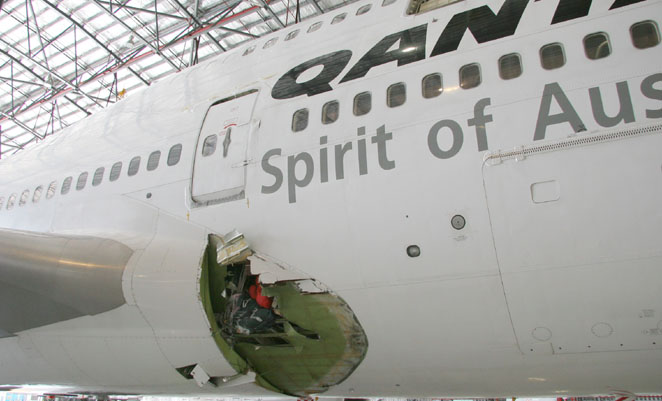
Qantas 747-438 VH-OJK was operating QF30 between Hong Kong and Melbourne on July 22 2008 when 55 minutes into the flight while cruising at 29,000ft the explosion of a pressurised oxygen cylinder (one of a number that provide passengers with emergency supplementary oxygen) tore a 2 x 1.5m hole in the aircraft’s fuselage, immediately forward of the right wing.
“The flightcrew reported the initial event as a ‘loud bang or cracking sound’, with an associated jolt felt through the airframe,” says the report. “The autopilot immediately disengaged and multiple alert messages were displayed on monitoring instrumentation. The flightcrew reported that upon noting a cabin altitude warning, they immediately donned oxygen masks and began executing the appropriate emergency procedures. A ‘MAYDAY’ radio call was made and an emergency descent initiated.”
After an emergency descent to 10,000ft, where supplementary oxygen is no longer reguired, the crew subsequently diverted to Manila, where the aircraft landed safely.
“Despite the apparent failure of multiple aircraft systems, the flightcrew reported that the descent and approach into Manila was uneventful, and the aircraft landed safely on runway 06 at 1111 local time,” notes the report.
According to the ATSB, investigations showed “it was evident that the oxygen cylinder (number 4 in a bank along the right side of the forward cargo hold) had burst in such a way as to rupture the adjacent fuselage wall and be propelled upwards; puncturing the cabin floor and impacting the frame and handle of the R2 door and the overhead cabin panelling. No part of the cylinder (other than the valve assembly) was recovered and it was presumed lost from the aircraft during the depressurisation.”