 iscover
Warning: Undefined array key "image-size-770" in /data/www/upgrade/australianaviation.com.au/httpdocs/wp-content/themes/australianaviation/functions.php on line 1310
Warning: Trying to access array offset on null in /data/www/upgrade/australianaviation.com.au/httpdocs/wp-content/themes/australianaviation/functions.php on line 1310
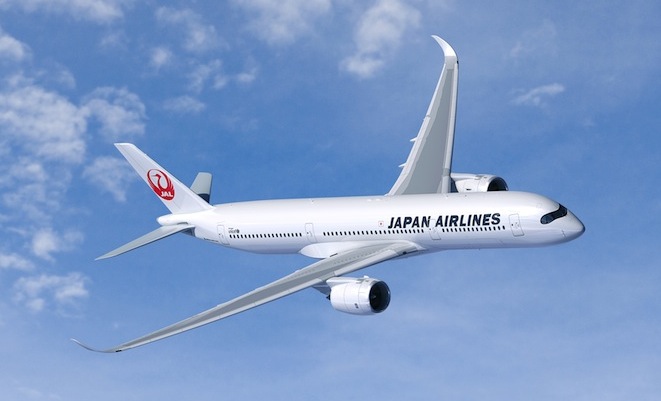
In a landmark deal that sees it loosen its historic ties with Boeing, Japan Airlines (JAL) has signed a purchase agreement with Airbus for 31 A350s. In its first ever order for Airbus aircraft, the deal comprises 18 A350-900s and 13 A350-1000s plus options for a further 25 aircraft, and is the first order for the A350 from Japan.
JAL is aiming for entering the A350s into service from 2019, with the A350s progressively replacing its older types over six years. The new aircraft will be powered by Rolls Royce Trent XWB engines.
This content is available exclusively to Australian Aviation members.
A monthly membership is only $5.99 or save with our annual plans.
- Australian Aviation quarterly print & digital magazines
- Access to In Focus reports every month on our website
- Unlimited access to all Australian Aviation digital content
- Access to the Australian Aviation app
- Australian Aviation quarterly print & digital magazines
- Access to In Focus reports every month on our website
- Access to our Behind the Lens photo galleries and other exclusive content
- Daily news updates via our email bulletin
- Unlimited access to all Australian Aviation digital content
- Access to the Australian Aviation app
- Australian Aviation quarterly print & digital magazines
- Access to In Focus reports every month on our website
- Access to our Behind the Lens photo galleries and other exclusive content
- Daily news updates via our email bulletin
The step away from Boeing is significant in many respects, since the commonality between JAL’s existing 777 fleet would have made the yet-to-be launched 777X a prime candidate for sales. Similarly, the airline’s current fleet of 787s would have positioned the larger variants of the type well to take advantage of the cost-efficiencies associated with operating a common aircraft fleet.
At the end of June, JAL had 166 Boeing aircraft in service, representing 78 per cent of the 214 aircraft in its fleet.
Only in May this year Airbus’s head of sales John Leahy is reported as saying; “I can say I’m looking for an improvement in our market share in Japan. We have nowhere to go but up.”
The influence of indigenous aerospace industry in the respective aircraft program sheds little light on the selection of the A350.
Japan’s aerospace industry is heavily involved in 787 component production. Fuji Heavy Industries produces the centre wing box for the 787, Jamco the aircraft’s internal fixtures, Kawasaki the fixed trailiing edge and forward fuselage, Mitsubishi the entire wing box and Panasonic the onboard cabin services system.
By comparison, Airbus has historically contracted Japanese aerospace firms for just three per cent of the A350. That will rise to around 12 per cent after Rolls Royce recently struck a deal with Mitsubishi to develop and supply components for the Trent XWB-97 that will power the -1000 variant of the A350, which JAL has ordered.

Airbus said: “Companies such as Bridgestone, Panasonic, Yokogawa Electric and Minebea contribute to all of Airbus’ current production aircraft, while Toray and Toho Tenax signed a long-term agreement in 2010 to supply carbon fibre for the company’s aircraft. In total, Japanese partnerships with Airbus range from 17 companies for the double-deck A380, to 12 each for the A320 and A330 Families, as well as four for the next-generation A350 XWB widebody.”
With competitor ANA currently in the market seeking new longhaul airframes, the JAL order will give added impetus to Airbus to capitalise on this week’s historic order. It may also break the hiatus for A380 sales in Japan.
In a typical three-class layout the A350-900 seats more than 300 passengers on routes as long as 8,100nm while the A350-1000 seats 350 passengers on even longer missions up to 8,400 nm.
To date the A350 MSN1 has completed around 300 flight test hours out of the campaign’s total 2,500 hours which are to be achieved by five flight test A350’s over the next 12 months. Entry into commercial service of the A350-900 is scheduled for the second half of 2014.