 iscover
Warning: Undefined array key "image-size-770" in /data/www/upgrade/australianaviation.com.au/httpdocs/wp-content/themes/australianaviation/functions.php on line 1310
Warning: Trying to access array offset on null in /data/www/upgrade/australianaviation.com.au/httpdocs/wp-content/themes/australianaviation/functions.php on line 1310
Warning: Undefined array key "image-size-770" in /data/www/upgrade/australianaviation.com.au/httpdocs/wp-content/themes/australianaviation/functions.php on line 1310
Warning: Trying to access array offset on null in /data/www/upgrade/australianaviation.com.au/httpdocs/wp-content/themes/australianaviation/functions.php on line 1310
Passenger numbers to regional mining centres fell significantly in 2015 as Australia’s softening resources sector prompted local carriers to reallocate capacity to other markets, new figures show.
The Bureau of Infrastructure, Transport and Regional Economics (BITRE) said Australia’s domestic airlines flew 60.12 million passengers in the 12 months to Decemeber 31 2015, which was broadly unchanged from the prior year.
This content is available exclusively to Australian Aviation members.
A monthly membership is only $5.99 or save with our annual plans.
- Australian Aviation quarterly print & digital magazines
- Access to In Focus reports every month on our website
- Unlimited access to all Australian Aviation digital content
- Access to the Australian Aviation app
- Australian Aviation quarterly print & digital magazines
- Access to In Focus reports every month on our website
- Access to our Behind the Lens photo galleries and other exclusive content
- Daily news updates via our email bulletin
- Unlimited access to all Australian Aviation digital content
- Access to the Australian Aviation app
- Australian Aviation quarterly print & digital magazines
- Access to In Focus reports every month on our website
- Access to our Behind the Lens photo galleries and other exclusive content
- Daily news updates via our email bulletin
The number of travellers on regular public transport (RPT) flights was flat at 57.49 million, while there were 2.63 million on charter services, down 1.3 per cent from the prior year.
With little passenger growth and a slight reduction in capacity, load factors rose 0.2 percentage points to 76.5 per cent.
“Load factors on individual routes increased on 33 of the 61 RPT routes for which data is available in both years,” the BITRE report said.
Mining routes suffer
There were big declines in passengers on mining-dominated routes in Western Australia and Queensland in 2015, led by Perth-Port Hedland down 20.1 per cent, Brisbane-Moranbah down 19.6 per cent and Brisbane Emerald down 14.7 per cent.
There were also double-digit falls on the Brisbane-Mount Isa (down 13.6 per cent) and Karratha-Perth (down 12.4 per cent) routes.

Qantas chief executive Alan Joyce said last month the airline group was expecting a $50 million hit to revenue in the 2015/16 second half from the weakening resources sector.
“Qantas Domestic continues to re-balance capacity from the resource sector towards east coast business and premium leisure markets,” Joyce said at Qantas’s 2015/16 first half results presentation on February 23.
And Regional Express (Rex) deputy chairman John Sharp said conditions were likely to remain subdued in the period ahead.
“Underlying business passenger demand is expected to continue to soften due to negative impact of plunging oil prices and continued China weakness,” Sharp said on February 24.
“The mining industry for example is slowing down dramatically. We are affected by that. A number of the towns and communities that we service have a mining component to them and the passenger numbers have declined there as a consequence of that. We anticipate that to continue.”
The BITRE report highlighted that some of Australia’s fastest-growing routes were to coastal cities along the east coast, as well as to the Red Centre.
RPT passenger numbers on the Ballina (Byron Bay)-Sydney route rose 11.9 per cent, while there were also healthy increases on Uluru-Sydney (up 10.3 per cent), Hamilton Island-Sydney (up 9.2 per cent) and Cairns-Melbourne (up 8.3 per cent).
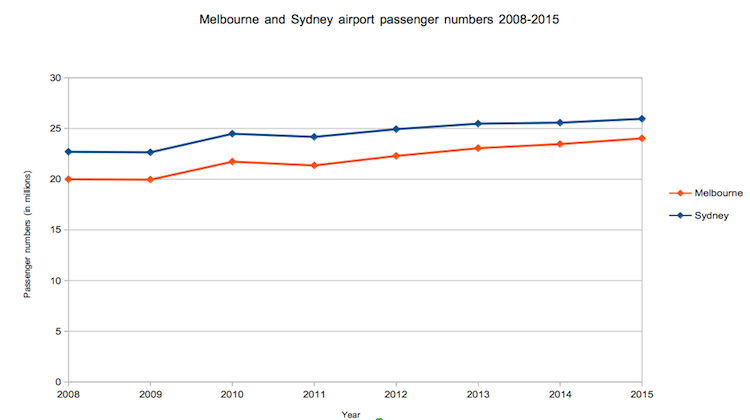
While Sydney Airport retained its position as Australia’s busiest airport in terms of passenger numbers, with 25.95 million travellers passing through its terminals in calendar 2015, the BITRE figures showed the gap to second-placed Melbourne Tullamarine (24.02 million) was narrowing, as the chart below shows.