
 iscover
Warning: Undefined array key "image-size-770" in /data/www/upgrade/australianaviation.com.au/httpdocs/wp-content/themes/australianaviation/functions.php on line 1310
Warning: Trying to access array offset on null in /data/www/upgrade/australianaviation.com.au/httpdocs/wp-content/themes/australianaviation/functions.php on line 1310
Warning: Undefined array key "image-size-770" in /data/www/upgrade/australianaviation.com.au/httpdocs/wp-content/themes/australianaviation/functions.php on line 1310
Warning: Trying to access array offset on null in /data/www/upgrade/australianaviation.com.au/httpdocs/wp-content/themes/australianaviation/functions.php on line 1310
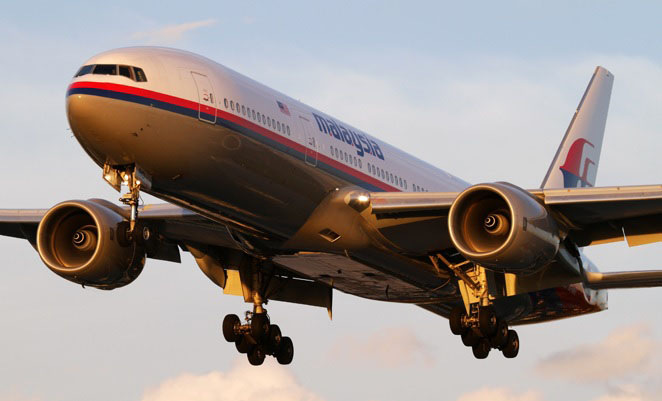
Two pieces of aircraft debris that washed up on the African coast in March were “almost certainly” to have come from missing Malaysia Airlines flight MH370, the Australian Transport Safety Bureau (ATSB) says.
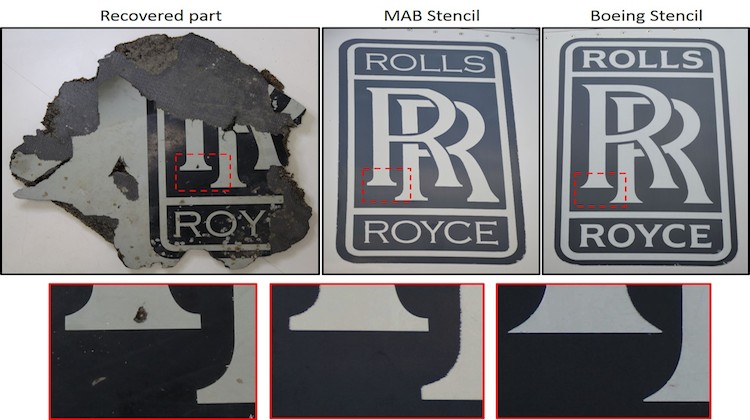
The ATSB’s report said one part, a segment from an aircraft engine cowling, featured a Rolls-Royce stencil font and details that was “consistent with that developed and used by Malaysian Airlines and closely matched exemplar stencils on other MAB Boeing 777 aircraft”.
This content is available exclusively to Australian Aviation members.
A monthly membership is only $5.99 or save with our annual plans.
- Australian Aviation quarterly print & digital magazines
- Access to In Focus reports every month on our website
- Unlimited access to all Australian Aviation digital content
- Access to the Australian Aviation app
- Australian Aviation quarterly print & digital magazines
- Access to In Focus reports every month on our website
- Access to our Behind the Lens photo galleries and other exclusive content
- Daily news updates via our email bulletin
- Unlimited access to all Australian Aviation digital content
- Access to the Australian Aviation app
- Australian Aviation quarterly print & digital magazines
- Access to In Focus reports every month on our website
- Access to our Behind the Lens photo galleries and other exclusive content
- Daily news updates via our email bulletin
However, the ATSB said there were “no significant differentiators on the cowling segment to assist in determining whether the item of debris was from the left or right side of the aircraft, or the inboard or outboard side the cowling”.
Meanwhile, the second part was determined to be an interior panel from the main cabin, given its decorative laminate, and associated with a closet near Door R1.
“The pattern, colour and texture of the laminate was only specified by MAB for use on Boeing 747 and 777 aircraft. There is no record of the laminate being used by any other Boeing 777 customer,” the ATSB report published on Thursday said.
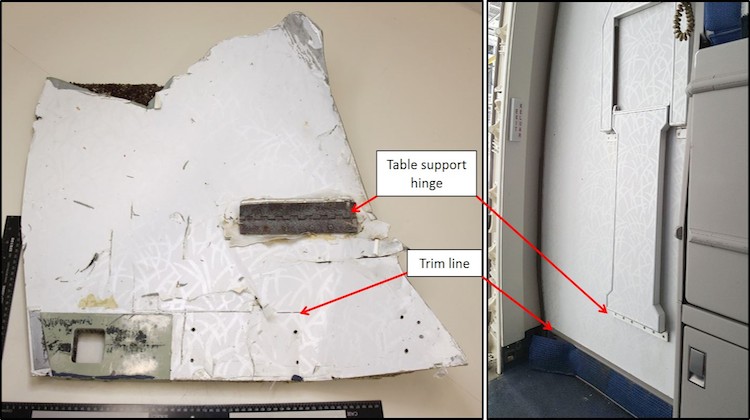
However, the ATSB report noted both parts did not have any identifiers that were unique to the aircraft, registration 9M-MRO.

The ATSB said the marine ecology and biological material was still being analysed.
The two parts, as well as a wing and a horizontal stabiliser discovered in Mozambique and a wing flaperon that washed up on the coast of Reunion Island are the only parts of the Boeing 777-200ER that have been found since it disappeared enroute from Kuala Lumpur to Beijing in March 2014 with 239 passengers and crew on board.
Efforts to locate 9M-MRO have centred around a 120,000 square kilometre area in the Indian Ocean, with 105,000 square kilometres having been searched so far. The search is likely to be completed by the middle of the year.







Steve
says:The laminate part is interesting as I think this is the only internal part from the fuselage so far discovered. This would imply that the fuselage broke up on impact rather than some sort of benign ditching.
Jakob karpin
says:I don’t quite understand why the chip/hole in the stencil.
Fabian mueller
says:I really don’t want the search to stop. It may be expensive but it’s worth while finding out what happened for the better future.
Steve
says:Jakob, the chip/hole appears to be from a flush rivet head that has probably sheared off during the cowl’s destruction. The rivet head was covered by the stencil, so when it went, it pealed the paint in that area.
Thomas of Doubt
says:Show me the MH tail empanage!
Murray Howlett
says:I think the fact that only one internal part has been found does not really imply that the fuselage broke up on impact. It appears from the photo to have been from near one of the doors – perhaps it somehow exit via this way. If the fuselage broke up on impact, I would have thought there would be more than one item from the interior found.
However the jury is still out until the wreck is found but I would not be too surprised if the plane is substantially in one piece – minus engines and the control surfaces that have been found. We shall see.