
 iscover
Warning: Undefined array key "image-size-770" in /data/www/upgrade/australianaviation.com.au/httpdocs/wp-content/themes/australianaviation/functions.php on line 1310
Warning: Trying to access array offset on null in /data/www/upgrade/australianaviation.com.au/httpdocs/wp-content/themes/australianaviation/functions.php on line 1310
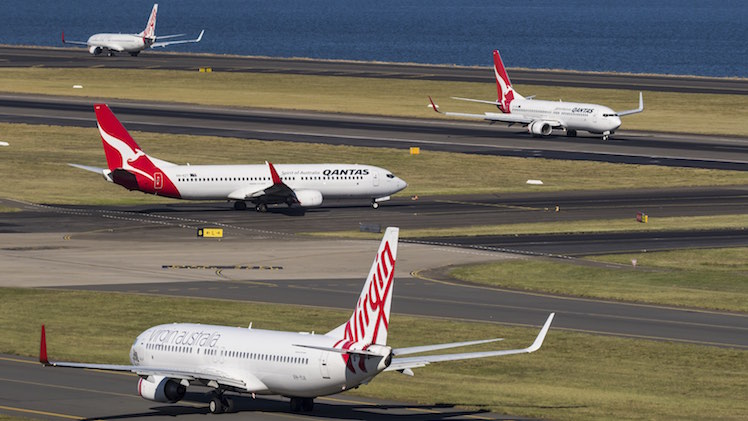
In the Australian news cycle, it seems Qantas and Virgin Australia are never too far away from the headlines. Over the past half-decade, the airlines have been critiqued for low share prices, a reduction in international routes as well as the unprecedented 2011 Qantas fleet grounding.
However, a recent report from the University of Sydney has named the two carriers among the most efficient in the world. It has also found both local airlines are very resilient, an insight that is perhaps not surprising given the market conditions both face as ‘end of line’ carriers.
This content is available exclusively to Australian Aviation members.
A monthly membership is only $5.99 or save with our annual plans.
- Australian Aviation quarterly print & digital magazines
- Access to In Focus reports every month on our website
- Unlimited access to all Australian Aviation digital content
- Access to the Australian Aviation app
- Australian Aviation quarterly print & digital magazines
- Access to In Focus reports every month on our website
- Access to our Behind the Lens photo galleries and other exclusive content
- Daily news updates via our email bulletin
- Unlimited access to all Australian Aviation digital content
- Access to the Australian Aviation app
- Australian Aviation quarterly print & digital magazines
- Access to In Focus reports every month on our website
- Access to our Behind the Lens photo galleries and other exclusive content
- Daily news updates via our email bulletin
The study, conducted by the Business School’s Institute of Transport and Logistics Studies, found that the age of the Qantas and Virgin fleets, uniformity in the type of aircraft flown and the number of aircraft in operation, gave the two Australian airlines an advantage in unit costs and operational efficiency over many other carriers.
Australia’s largest airline, Qantas, performed better out of the two. It was ranked the 20th most efficient airline out of 150 surveyed globally.
This result was calculated using a new algorithm which looks at passengers per number of aircraft, seat kilometres flown, the airline’s fleet, staffing levels, perceived service levels and profitability.
“Qantas was near the top in all of the single efficiency measures that we established, so overall Qantas did quite well,” said Associate Professor Rico Merkert. “Virgin Australia didn’t do as well but was still better than the average.”
The overall resilience of the carriers suggests they are well placed to handle changing market dynamics such as oil price fluctuations. Much of this comes down to future planning, with both airlines participating in hedging to reduce costs.
“Both engage in fuel hedging,” Dr Merket said. “They also engage in foreign exchange hedging as quite a lot of their cost and debts are serviced in US dollars. They also hedge interest rates and to some extent cash flows.”

Interestingly, the report found that consistently good customer service did not always correlate with repeat business, higher yields or higher profits.
“Virgin America for many years was featuring very high in all quality rankings but never made much profits out of that exercise. At the other end of the spectrum you have Ryanair, providing a very low level of service but cheap fares and customers come back and they make huge profits,” Dr Merkert said.
The study also looked at the efficiencies achieved through mergers and acquisitions.
“Usually the result of a merger… is positive. Capacity is taken out, synergies are leveraged and yields and profitability improve.”
However, the study found that bigger isn’t always better, with some mergers actually resulting in a reduction of efficiency within the new carrier.
“Our research has shown, however, that airlines can actually become too big to operate efficiently. Once you get to a certain size, and we’re talking about 200 billion available seat kilometres you get airlines that actually experience dis-economies of scale,” Dr Merkert explained.







Richard
says:Quite a change from the QF of 2011. Looks like the long term strategy paid off.
Vannus
says:QANTAS has been flying a lot longer than Virgin.
Will be ONE HUNDRED years, in 2020!
Funny how originally, Virgin wasn’t going to have Airport Lounges, a frequent flyer scheme, or Business Class, but Branson soon realised he wasn’t going to be able to compete with QF unless he did all that, & then some.
Even though Virgin has John Borghetti, a 36 years’ long employee of QF, before he resigned, as CEO now, they’ve got much ‘catching up’ to do.
Will they ever ‘make it’? Doubt it……………..