
 iscover
An ATSB investigation has cited turbulence as a factor in an R44 crash that killed a 34-year-old instructor and his trainee.
The report into the December 2020 incident concluded the adverse conditions or potentially “inappropriate” pilot actions led to the helicopter’s rotor blade colliding with its main rotor shaft.
This content is available exclusively to Australian Aviation members.
A monthly membership is only $5.99 or save with our annual plans.
- Australian Aviation quarterly print & digital magazines
- Access to In Focus reports every month on our website
- Unlimited access to all Australian Aviation digital content
- Access to the Australian Aviation app
- Australian Aviation quarterly print & digital magazines
- Access to In Focus reports every month on our website
- Access to our Behind the Lens photo galleries and other exclusive content
- Daily news updates via our email bulletin
- Unlimited access to all Australian Aviation digital content
- Access to the Australian Aviation app
- Australian Aviation quarterly print & digital magazines
- Access to In Focus reports every month on our website
- Access to our Behind the Lens photo galleries and other exclusive content
- Daily news updates via our email bulletin
The aircraft crashed in the Bungonia State Conservation Area, NSW, killing pilot Nicholas Brink and Andrew Goldman, a 54-year-old Moira Shire councillor.
Newspaper reports at the time suggested it took the emergency crew six hours to find the wreckage, which caught fire at night.
The ATSB’s director of transport safety, Stuart Macleod, said, “Pilots should avoid flying downwind of hills, ridges or other potential sources of turbulence, particularly during changing or unpredictable weather conditions, and should use slow and small control inputs when encountering turbulence.”
The Robinson R44, VH-HGU, was operated by Hughes Helicopters and broke up as a result of “extreme teetering” due to turbulence or inappropriate control inputs, or both.
A search was launched after the aircraft failed to return from a training flight from Goulburn Airport, in the Southern Tablelands region of NSW, on the afternoon of 2 December 2020.
Wreckage of the R44 was found later that evening around 31 kilometres east of Goulburn. The accident site was also 4 km north-west of the helicopter’s last recorded ADS-B transmission, which indicated it was descending into a valley.

The helicopter’s engine and fuselage had been exposed to fire, which self-extinguished before emergency services arrived.
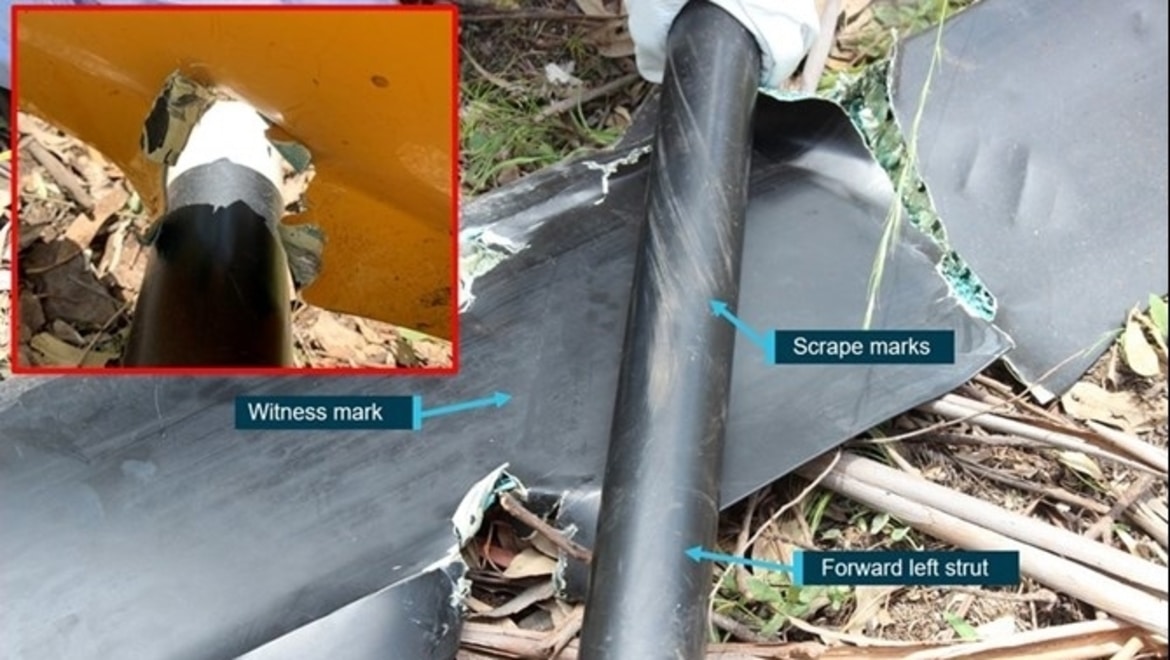
ATSB investigators surveyed the wreckage trail and main wreckage site and, despite fire damage, recovered and examined several components of the helicopter’s main rotor.
Examinations confirmed a “mast bump” had occurred, and that the helicopter had subsequently broken up in flight.
“Mast bumping is where the inboard end of the main rotor blade contacts the helicopter’s main rotor shaft,” Macleod explained.
In R44 helicopters, this can generally be identified by extensive damage to the teeter stops and varying degrees of damage to the main rotor shaft.
“The semi-rigid – or teetering – main rotor design of the R44 and several other popular helicopters relies on rotational force to lift the blades off the droop stops on the rotor hub during flight,” Macleod said.
“During normal operation, the rotor is free to teeter and flap around its designed flight axis via the teeter hinge, while polyurethane teeter stops limit the degree of teetering.”
A mast bump can occur when extreme teetering causes the rotor blades to exceed this allowance and contact the rotor hub at a high speed.
“The ATSB investigation found that, while flying in the vicinity of the valley, the helicopter entered a low-G condition due to turbulence, inappropriate control inputs, or a combination of both,” Macleod said.
“Low-G conditions can be catastrophic for helicopters with semi-rigid rotor heads. A pilot’s ability to recover from low-G remains uncertain and would be dependent on airspeed and time available. Pilots must therefore avoid low-G situations.”
Macleod also noted pilots should make a careful study of terrain, forecasts and observations applicable to a proposed flight, to identify in advance any significant weather or mechanical turbulence and avoid flying in these conditions.
The investigation report urged operators to consider the benefits of installing recording devices on their helicopters.
“While the fire would likely have prevented data recovery in this case, the inclusion of readily-available cockpit video recorders on helicopters with semi-rigid rotor heads would provide valuable insights into low-G mast bumping events, which could help prevent future occurrences,” Macleod concluded.
Since the accident, Robinson has introduced cockpit video/audio recorders as standard equipment on new R44s, having previously been available on the larger R66 models.
The recorders are currently optional on the smaller R22s but will also become standard on these models in 2023, with retrofit kits made available.