iscover
This content is available exclusively to Australian Aviation members.
A monthly membership is only $5.99 or save with our annual plans.
- Australian Aviation quarterly print & digital magazines
- Access to In Focus reports every month on our website
- Unlimited access to all Australian Aviation digital content
- Access to the Australian Aviation app
- Australian Aviation quarterly print & digital magazines
- Access to In Focus reports every month on our website
- Access to our Behind the Lens photo galleries and other exclusive content
- Daily news updates via our email bulletin
- Unlimited access to all Australian Aviation digital content
- Access to the Australian Aviation app
- Australian Aviation quarterly print & digital magazines
- Access to In Focus reports every month on our website
- Access to our Behind the Lens photo galleries and other exclusive content
- Daily news updates via our email bulletin
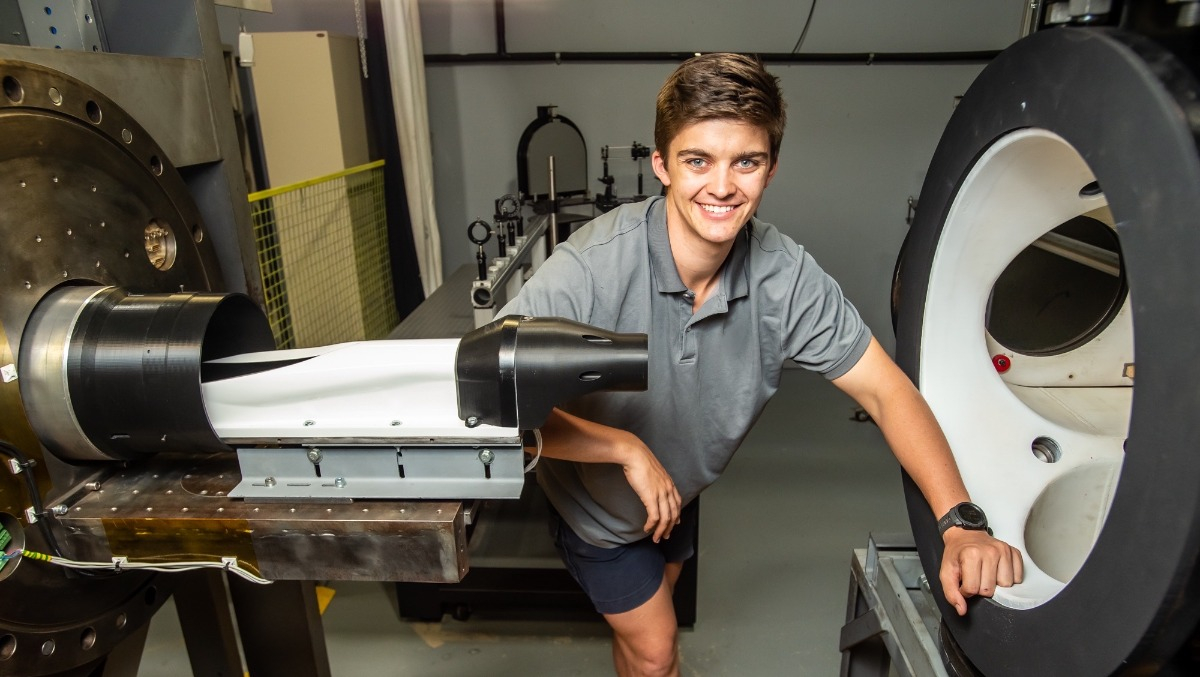
A University of Southern Queensland PhD student is working on a hypersonic engine that could fly from Sydney to London in less than four hours.
Lachlan Noller has been working on improving scramjet engines as part of his PhD research into high-speed travel options.
Under supervisor Fabian Zander, Noller has been working with the university’s trailblazing Hypersonics Group to find improvements to the team’s existing hypersonic technology.
“Essentially, what we’re doing is expanding the operation duration of scramjet inlets — super fast, experimental engines that move five times the speed of sound,” Noller said.
“My part involves developing new methods to help restart scramjets if or when they stop working.”
As part of the research, Noller and his colleagues in the Hypersonics Group carry out tests and experiments in their specially designed hypersonic wind tunnel.

Speaking about his work, Noller praised the university environment that allowed him to work on his research.
“At the University of Southern Queensland, we are lucky enough to have Australia’s longest duration hypersonic wind tunnel, as well as leading scientists from across the world.”
While hypersonic tech — defined as flying at least five times the speed of sound — is nothing new, countries are currently racing to develop the next generation of vehicles and missiles that are so manoeuvrable in mid-air that they can’t be intercepted or detected.
There are currently two major ways it’s thought manoeuvrable hypersonic vehicles and missiles could work.
The first, known as a hypersonic cruise missile, would see a rocket blast to Mach 5 before using an air-breathing engine, or scramjet, to maintain its momentum.
The second, known as a glide vehicle, sees a rocket blast into the sky before releasing a separate hypersonic missile that has built up enough velocity to travel under its own speed.
The advances are also being used to create scramjet-powered, hypersonic spaceplanes, which could one day provide an alternative to rockets for taking satellites into space. USQ already has its own pioneering wind tunnel that can simulate the effect of Mach 5 speeds on vehicles and the heat it generates.
You can listen to Australian Aviation’s podcast with USQ’s Dr Fabian Zander, above.