
 iscover
Warning: Undefined array key "image-size-770" in /data/www/upgrade/australianaviation.com.au/httpdocs/wp-content/themes/australianaviation/functions.php on line 1310
Warning: Trying to access array offset on null in /data/www/upgrade/australianaviation.com.au/httpdocs/wp-content/themes/australianaviation/functions.php on line 1310
Warning: Undefined array key "image-size-770" in /data/www/upgrade/australianaviation.com.au/httpdocs/wp-content/themes/australianaviation/functions.php on line 1310
Warning: Trying to access array offset on null in /data/www/upgrade/australianaviation.com.au/httpdocs/wp-content/themes/australianaviation/functions.php on line 1310
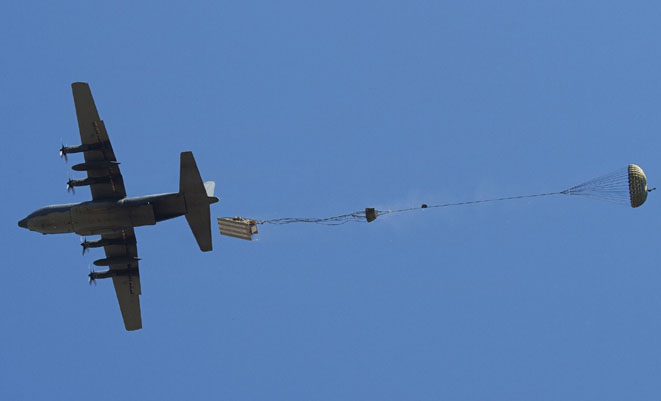
The RAAF made its last heavy airdrop from the C-130H Hercules when a 10-tonne bulldozer was delivered by parachute extraction into the Londonderry Drop Zone in northwestern Sydney on October 31.
The exercise was part of a trial to certify the bulldozer, a type under evaluation by the Australian Army, as suitable for airdrops.
This content is available exclusively to Australian Aviation members.
A monthly membership is only $5.99 or save with our annual plans.
- Australian Aviation quarterly print & digital magazines
- Access to In Focus reports every month on our website
- Unlimited access to all Australian Aviation digital content
- Access to the Australian Aviation app
- Australian Aviation quarterly print & digital magazines
- Access to In Focus reports every month on our website
- Access to our Behind the Lens photo galleries and other exclusive content
- Daily news updates via our email bulletin
- Unlimited access to all Australian Aviation digital content
- Access to the Australian Aviation app
- Australian Aviation quarterly print & digital magazines
- Access to In Focus reports every month on our website
- Access to our Behind the Lens photo galleries and other exclusive content
- Daily news updates via our email bulletin
Commanding Officer of Air Movements Training and Development Unit (AMTDU) WGCDR Carl Newman said airdrops can place massive stresses on the load and aircraft alike.
“The objective is to ensure that airdrop of the load does not adversely impact the aircraft, and that the bulldozer is in working order after the airdrop,” Wing Commander Newman said.
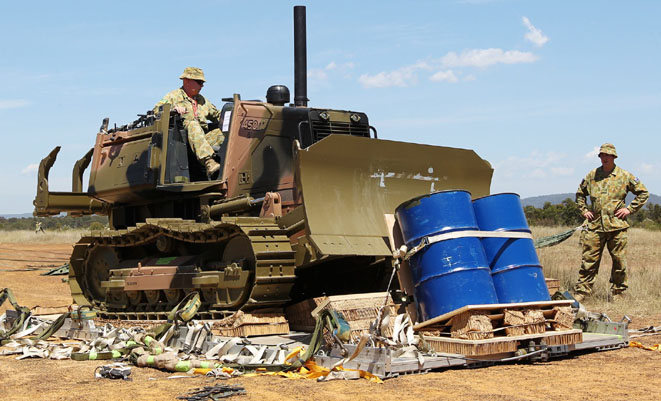
“Even descending beneath five parachutes, the impact of this load hitting the ground would significantly damage most family cars or commercial trucks were they the cargo. Defence has worked with industry to design and deliver a bulldozer that is fit to handle the stresses involved in airdrop delivery.”
Heavy airdops will in future be undertaken by the C-130J and C-17 transports following retirement of the C-130H on November 30.
View footage of the drop here.








pez
says:I got it, I got it!! *splat*
Tim Cheney
says:I’m glad that the chutes worked or I would have had here in the UK!!!!!
Rex
says:Not much point in it if there’s no airborne combat team.
Dave
says:I vividly recall this same exercise being done circa 1973/74 when a bulldozer was dropped out the back of one of the RNZAF C130Hs onto the Raumai Range to the west of the RNZAF Base Ohakea. I was onboard and took a nice silohouette photo of the load exiting the rear of the aircraft. Exercise was a great success and after the palletised bulldozer landed (which had compressed the cardboard packing sufficiently) it was started and driven off the pallet.
Ted
says:Low Altitude Parachute Extraction System (LAPES) is conducted near the ground (around 1-3 metres) and uses a parachute for extraction only. The load falls the short distance to the ground with no other parachutes. There is some good footage of American C-130s delivering a bulldozer by LAPES. The practice was discontinued following some loads jamming on exit resulting in an aircraft crash. The only RAAF aircraft that continued with LAPES were the Caribous until their retirement.
Robert Murray
says:i saw this drop as i lived next to the drop zone . i saw many drops go wrong