
 iscover
Warning: Undefined array key "image-size-770" in /data/www/upgrade/australianaviation.com.au/httpdocs/wp-content/themes/australianaviation/functions.php on line 1310
Warning: Trying to access array offset on null in /data/www/upgrade/australianaviation.com.au/httpdocs/wp-content/themes/australianaviation/functions.php on line 1310
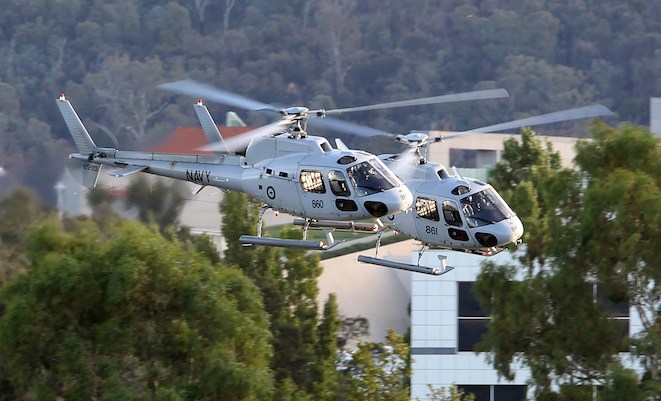
The Navy has celebrated 30 years of service of 723 Squadron’s AS350 BA Squirrels, marking the arrival for the first ‘Battle Budgie’ at HMAS Albatross, Nowra on May 14 1984.
The white and navy blue AS350 B Squirrels were part of an initial buy of 24 helicopters for the ADF, with an original six Squirrels being used by Navy’s then HC-723 Squadron in the light utility, SAR, and the Interim Embarked Training Helicopter roles.
This content is available exclusively to Australian Aviation members.
A monthly membership is only $5.99 or save with our annual plans.
- Australian Aviation quarterly print & digital magazines
- Access to In Focus reports every month on our website
- Unlimited access to all Australian Aviation digital content
- Access to the Australian Aviation app
- Australian Aviation quarterly print & digital magazines
- Access to In Focus reports every month on our website
- Access to our Behind the Lens photo galleries and other exclusive content
- Daily news updates via our email bulletin
- Unlimited access to all Australian Aviation digital content
- Access to the Australian Aviation app
- Australian Aviation quarterly print & digital magazines
- Access to In Focus reports every month on our website
- Access to our Behind the Lens photo galleries and other exclusive content
- Daily news updates via our email bulletin
The first batch of five new Squirrels arrived at RAAF Base Fairbairn, Canberra on April 28 1984 direct from the French manufacturer, Aerospatiale, onboard a RAAF Boeing 707, 21 months after contract signature. After re-assembly and testing, the Navy’s first Squirrel, N22-014, flew the short distance to Nowra.
The RAAF used 12 in the helicopter pilot training role, replacing the ageing UH-1B Iroquois at 5 Squadron, Canberra. The Air Force had planned to use six Squirrels for SAR capabilities at RAAF bases Pearce, Williamtown and Darwin, however this proved unsuccessful and they were returned to 5 Squadron. All the RAAF’s Squirrels were eventually transferred to the Army in 1990.
The Navy’s Fleet Air Arm currently operates 13 Squirrels (the six original cabs plus seven former RAAF/Army machines), upgraded to AS350 BA models for improved capability and performance in 1995, and are used primarily for pilot, aviation warfare officer and aircrewman training with 723 Squadron.
Eleven Squirrels have been made surplus sold off or are used as training aids.








Damian
says:I could be wrong but fitting five disassembled squirrels inside a RAAF 707 seems like a very difficult task!
David
says:Do I recall that the sold off aircraft were snapped up by civil operators.
The ADF sold the aircraft under the impression that they could not be flown under a civil registration because they did not have a type certificate.
If fact they did have a civil type certificate!
Gary
says:They certainly did get 5 in the 707. They arrived at Fairbairn with “performance” figures written in texta across the plastic on their windscreens by the 707 crew….alt 30000 ft, speed 500 MPH etc..! The hardened tradies at 5 Squadron who were fixated on Iroquois at the time said they were plastic rubbish and would not last. They have certainly proven them wrong. Its a pity they went back to Kiowa for training. The Squirrel was a far better machine for maintenance.
Martin
says:Gary, Like Damian, I was surprised to read 5x Squirrels in 1x 707. Was the tail boom detached from the helicopters? Otherwise I would have thought it would have been tricky even manoeuvring them through the cargo door. They must also have had their bellies close to the cabin floor if engines were still fitted?? Perhaps we just think interior of 707 was more squeezy than it really was!