
 iscover
Warning: Undefined array key "image-size-770" in /data/www/upgrade/australianaviation.com.au/httpdocs/wp-content/themes/australianaviation/functions.php on line 1310
Warning: Trying to access array offset on null in /data/www/upgrade/australianaviation.com.au/httpdocs/wp-content/themes/australianaviation/functions.php on line 1310
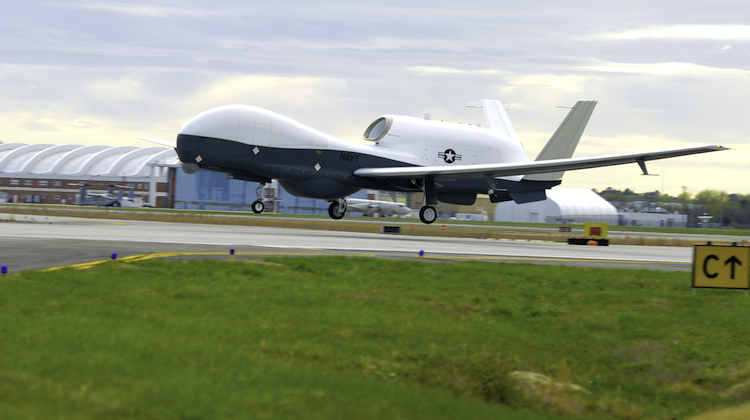
The Northrop Grumman MQ-4C Triton unmanned aircraft system (UAS) has completed its inaugural flight equipped with a new radar system, following its first flight from Naval Air Station Patuxent River in Maryland on April 16.
The US Naval Air Systems Command (NAVAIR) stated that the flight marking the start of sensor testing activities was conducted on April 18 in airspace over Patuxent River.
This content is available exclusively to Australian Aviation members.
A monthly membership is only $5.99 or save with our annual plans.
- Australian Aviation quarterly print & digital magazines
- Access to In Focus reports every month on our website
- Unlimited access to all Australian Aviation digital content
- Access to the Australian Aviation app
- Australian Aviation quarterly print & digital magazines
- Access to In Focus reports every month on our website
- Access to our Behind the Lens photo galleries and other exclusive content
- Daily news updates via our email bulletin
- Unlimited access to all Australian Aviation digital content
- Access to the Australian Aviation app
- Australian Aviation quarterly print & digital magazines
- Access to In Focus reports every month on our website
- Access to our Behind the Lens photo galleries and other exclusive content
- Daily news updates via our email bulletin
The AN/ZPY-3 Multi-Function Active Sensor (MFAS) active electronically scanned array (AESA) radar is expected to greatly enhance maritime domain awareness by providing Triton with a 360-degree view of a large area, while providing all-weather coverage to expedite detecting, classifying, tracking and identifying potential targets, according to NAVAIR.
“This first sensor flight is a huge achievement for the program,” said Sean Burke, program manager for the Persistent Maritime Unmanned Aircraft Systems Program Office headquartered at Pax River.
“Our [US] Navy and Northrop Grumman team has worked extremely hard on this developmental effort, completing more than 40 surrogate flights over the last three years, and we saw the realisation of that development work.”
During this initial test event, the MFAS radar exercised its primary operating mode known as maritime surface surveillance, which provides a continuous monitoring capability covering a broad area.
Triton aircraft will also be equipped with the MTS-B Multi-Spectral Targeting System, which provides electro-optical, infrared, laser designation and laser illumination capabilities; an electronic support measures (ESM) package to identify and geolocate radar threat signals; and an Automatic Identification System (AIS) capability to detect and track vessels with AIS responders.
The federal government has committed to acquiring the UAS for the Royal Australian Air Force (RAAF) subject to the satisfactory execution of the US Navy development program.

Triton is intended to complement the Boeing P-8A Poseidon, replacing the AP-3C Orion under AIR 7000. About seven of the high-altitude long-endurance (HALE) aircraft are expected to eventually be based at RAAF Base Edinburgh, north of Adelaide.
The precise number to be acquired by Australia, and their scheduled introduction into service date, is anticipated to be considered by the government at some point next year, following the release of the 2015 Defence White Paper.







Tom
says:I imagine that they have some different systems but what is the difference between these Tritons and the Global Hawk 30’s?
Corey
says:I hope the RAAF buy an additional 4 P-*8A Poseidons for a fleet of 12 but a fleet of 24 would be nice.