 iscover

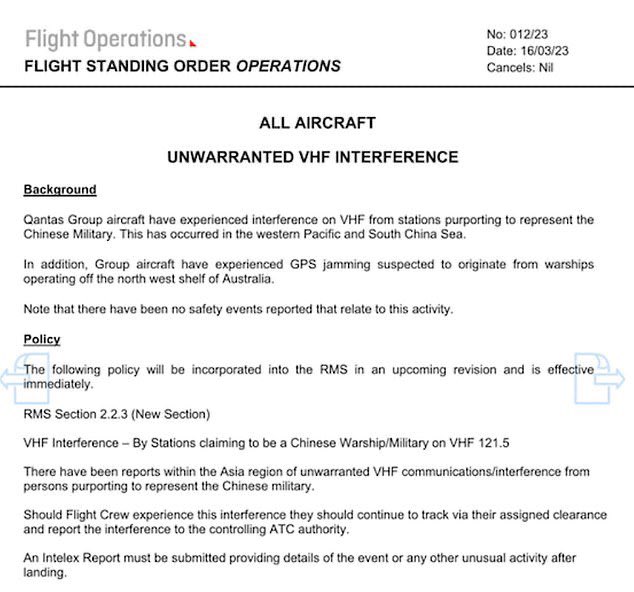
Qantas pilots are receiving radio interference and GPS jamming from what the airline believes are Chinese warships in the Asia Pacific.
The revelation came in a note to pilots issued by the business on Thursday, which advised crew members to fly on but report the matter to air traffic control.
This content is available exclusively to Australian Aviation members.
A monthly membership is only $5.99 or save with our annual plans.
- Australian Aviation quarterly print & digital magazines
- Access to In Focus reports every month on our website
- Unlimited access to all Australian Aviation digital content
- Access to the Australian Aviation app
- Australian Aviation quarterly print & digital magazines
- Access to In Focus reports every month on our website
- Access to our Behind the Lens photo galleries and other exclusive content
- Daily news updates via our email bulletin
- Unlimited access to all Australian Aviation digital content
- Access to the Australian Aviation app
- Australian Aviation quarterly print & digital magazines
- Access to In Focus reports every month on our website
- Access to our Behind the Lens photo galleries and other exclusive content
- Daily news updates via our email bulletin
However, the Flying Kangaroo insisted there had been “no safety events” reported related to the problems.
It follows the International Federation of Air Line Pilots’ Associations (IFALPA) issuing a statement earlier this month confirming the interference, which it said was prevalent over the South China Sea, the Philippine Sea and east of the Indian Ocean.
It told members it was working with IATA and the Air Navigation Service Providers (ANSPs) to tackle the issue and even revealed that, in some cases, airlines adjusted their flight path to mitigate the matter.
“If a warship attempts to call your flight, utilize the following procedures,” read the advice. “Do not respond to the warship. Immediately report the contact to the controlling ATC agency.
“Notify your company’s dispatcher of the attempted contact. Complete an ASAP report, or other company safety report for either non-ATC communication or GNSS interference.”
Qantas captain Tony Lucas, who is also the president of the Australian and International Pilots Association, downplayed any safety concerns in an interview with The Guardian.

“Our members are aware of recent reported communication and electronic interference,” he said.
“Qantas Group pilots are well trained and remain ready to manage these sorts of issues safely in accordance with defined procedures.”
It follows a more serious military incident over the South China Sea last year when a Chinese J-16 cut across the nose of a RAAF P-8 Poseidon.
The conflict saw the fighter jet accelerate so close to the Australian aircraft that a “bundle of chaff” was ingested into its engine.
Defence Minister Richard Marles said the P-8 returned back to base safely but added the incident would not deter the RAAF from continuing to fly over the disputed area.
The RAAF P-8 Poseidon is a maritime patrol aircraft used for a variety of roles, including reconnaissance and search and rescue.
Best known as a military variant of the Boeing 737, it’s equipped with advanced sensors and mission systems, including a multi-role radar, high-definition cameras and a high-processing acoustic system and an extensive communications suite.
Australia’s Poseidon fleet is based at RAAF Base Edinburgh and was introduced to partially replace the RAAF’s fleet of AP-3C Orions, together with the MQ-4C Triton unmanned aircraft system.