
 iscover
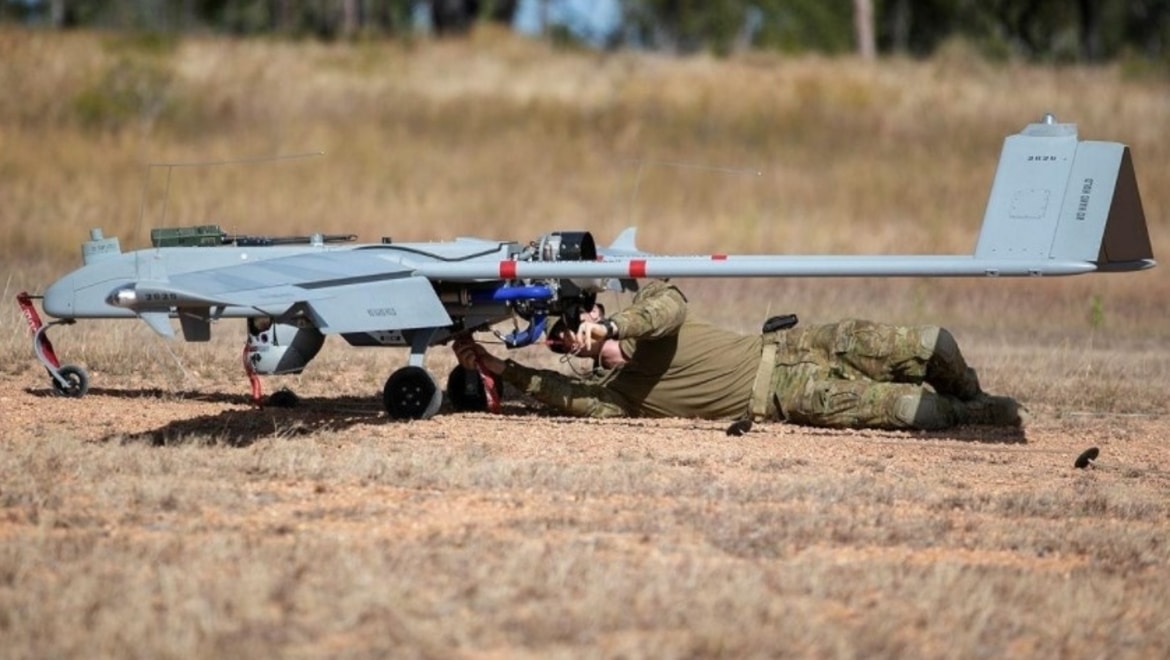
Army’s Shadow 200 drones used their lasers to identify targets 9,000 feet in the air during recent exercise Dragon Sprint.
The UAV is equipped with high resolution cameras and fed back information to Tiger helicopters and M777A2 Howitzers, which launched Hellfire missiles that the Shadows then guided onto their targets.
This content is available exclusively to Australian Aviation members.
A monthly membership is only $5.99 or save with our annual plans.
- Australian Aviation quarterly print & digital magazines
- Access to In Focus reports every month on our website
- Unlimited access to all Australian Aviation digital content
- Access to the Australian Aviation app
- Australian Aviation quarterly print & digital magazines
- Access to In Focus reports every month on our website
- Access to our Behind the Lens photo galleries and other exclusive content
- Daily news updates via our email bulletin
- Unlimited access to all Australian Aviation digital content
- Access to the Australian Aviation app
- Australian Aviation quarterly print & digital magazines
- Access to In Focus reports every month on our website
- Access to our Behind the Lens photo galleries and other exclusive content
- Daily news updates via our email bulletin
The exercise was held at the Townsville Field Training Area from 21-23 June, and the UAVs were flown by gunners of the 131st Battery, 20th Regiment, Royal Australian Artillery.
20th Regiment Adjutant Captain Christopher Moroney said using Shadows for target acquisition meant less risk to other assets.
“Shadow can designate a vehicle-size target with as much accuracy as a Tiger. This reduces the risk to the Tiger – or another manned platform – doing it for itself,” he said.
“This, however, does not replace the ground-based observer, as we are a weather-dependent system.”
Bombardier Bryson Smith, from the 106th Battery, 4th Regiment, Royal Australian Artillery, said using Shadows meant forward observers don’t need to get so close to dangerous targets.
“They have to have a good line of sight to call in effective fire, so with UAVs, they do not need to be as close to the target and you can get a better acquisition and we can fire more effective rounds.”

With a range of 125km, the Shadow can fly well past the artillery’s maximum range.
This was further extended during the exercise by dislocating the Shadow operators 50 kilometres from the airfield, creating a battery forward position.
Laser designation principles mean the closer the Shadow is to the target, the more accurate it will be, and during the exercise, 12 successful Hellfire designations were achieved.
“Apart from range and target information, we can provide video, stills and have the ability to observe day and night using infrared,” CAPT Moroney said.
“Being an aerial observer, it gives us a better perspective of the battlefield and you always want height and good optics to engage the target. This allows adjustments to be made more efficiently.”
CAPT Moroney said the development of the capability was driven by the progression of training.
“First, we work in the simulator, and then practise it and execute it for real,” he said.
“It ultimately proves the system works and the soldiers are ready.”
The training value of Exercise Dragon Sprint was also extended to the School of Army Aviation, which brought in their aircraft and crews.
The school’s Commanding Officer, Lieutenant Colonel Scott Doré, said the school brought their entire Tiger training staff along with three trainee pilots to the exercise, and it was the first time they had worked with the 20th Regiment.
“It is a unique opportunity for us to develop our staff and for our trainees to see and be exposed to training they would not normally have the opportunity to at this point,” he said.
“We train our gunnery on a simulator and you do not get all the learning associated with expending live rounds and going through the range safety planning involved with a live-fire activity.”
Exercise Dragon Sprint was the final in a series leading up to Exercise Talisman Sabre, which begins this month.
Army acquired its first Shadow in 2011, and the drones flew 10,000 hours in Afghanistan.